Stephen Seminar Number 4: Political Authority

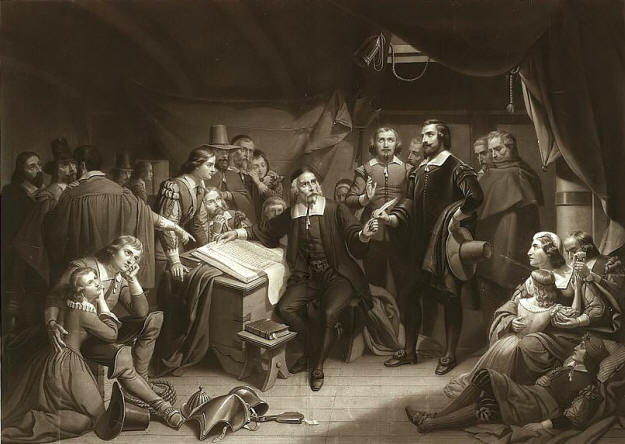
William Brewster Signing Mayflower Compact

Today the fourth Stephen Seminar kicked of with a bit of confusion. The expected speaker could not attend, but still we went forth to talk about political stability in light of modern problems.


Political stability does not come from itself, it stems from political authority. But political authority has different ways of manifesting. Previously authority would come from the outside. With two distinct modes coming to light, either a god entity or tradition. 


God entity can be anything of person who applies the rules and then there just has to adhered to or else one would be exiled. Tradition would be anything that has to do with repetition, repeating the same thing over and over again later forms a formal structure that governs. 


A modern development taking root in the Mayflower Compact is that governing bodies come to life on the basis of a promise. This promise would exist between people with the same set of ideals and would then promise each other to adhere to this specific set of norms. 


Rejecting that authority should come from outside like that of the monarchy or god, but that authority should come from within. Outside authority presupposes violence according to the speaker. Inner authority eliminates violence, because when there is violence from within the body it will inevitable self destruct. 


Complexity theory also comes to play in this ‘promise structure’. Like the brain, relationships are very complex. Neural patterns form structure over time through repetition. That is why it is important to repeat this promise to each other to keep the body united. This can be done through discourse in discussion of situations at hand or simply stating a credo. 


Thus was proposed that political authority should be coming from the outside in order to be effective for the people

skerp

steeds deur die krake val stukkies diamant
dit skommel in my binneste rond
en sny my ingewande aan elke kant
nader al nader aan my hart

die diamantjies wil nie uit nie
dit bly steeds
onwillekeurig
dit wil nie uit nie

vleishart word kliphard, kliphart
sag van buite, hard van binne

beheers deur vrees

– Francois van Dijk

Stephen Seminar Number 3: Pessimism of the diagnosis and optimism of prescription.

Timbuktu manuscripts of an old Astronomy Table

Today the Stephen Seminar was hosted by two speakers on African Philosophy. The first speaker went on to talk about truth and that an important part of truth-value is situated in the self. 


He mentioned Timbuktu as an example of just advanced Africa was in a sense. Timbuktu a small place that sits in the void away from everything and everybody, associated with nothingness, is busy compiling a library with text dating back as far as 8900BC. 


This just goes to show that the intelligence of Africa should not be underrated as it now has from in the form of ancient Arabic texts that it has in fact got an academic background. This also places Timbuktu in a sphere of universality in the sense that it now engages with the world on academic level from its individual level of truth. 


The second speaker talked about perception and how it can really blind a person if he does not explore the situation for himself. He mentioned Ethiopia as an example and went on to say that when Ethiopia comes up in any conversation that the first thoughts running through our minds are of starving kids famine stricken. 


This is again a perception because very little people with an academic background have been in Ethiopia and are aware of a 40-year plan to relief the situation. This plan is on the scale of HIV/AIDS and is getting allot of attention. This action plan has in mind to develop new ideas for energy efficiency, creating jobs, and land reform. 


In essence the speakers both had one forthcoming message; that opinion should not be made public unless it is an informed opinion.